

Best Hunting Gear for Seniors: What to Look For
Table of Contents
- Best Hunting Gear for Seniors: What Actually Matters
- How to Choose Gear That Reduces Joint Strain
- Layering Systems for Thermal Regulation After 50
- 5 Best Stretches for Hunters Before Long Hikes
- Lightweight Game Hauling Solutions That Save Your Back
- Footwear, Cutting Tools, and Field Dressing Gear
- Common Gear Mistakes Senior Hunters Make
- Conclusion: Gear Built for the Long Haul
- Frequently Asked Questions
Last Updated: October 5, 2026
Best Hunting Gear for Seniors: What Actually Matters
The best hunting gear for seniors reduces load, limits bending and lifting, and stays adjustable with stiff hands or sore joints.
This guide from Elk Hauler covers what matters when choosing gear after 50.

Here's what most gear reviews skip: a younger hunter can muscle through a bad pack-out and recover in a day, while an older hunter pays for it for a week.
How to Choose Gear That Reduces Joint Strain
Joint strain comes from three things: total weight, awkward positions, and gear that won't adjust to your body. Fix those and most of the ache disappears.
Weight Limits and Articulated Fit
Set a hard weight ceiling before you shop, then refuse to break it. Many hunters over 50 find that keeping total carried load under roughly a fifth of their body weight makes a full day realistic, though that varies by fitness and terrain.
Articulated fit means the garment or pack is cut with extra panels and seams at the shoulders, elbows, and knees so it moves with you.
Ease of Adjustment for Stiff Hands
Buckles, zippers, and straps are where arthritis shows up first. Look for:
- Oversized zipper pulls you can grab with gloves or cold fingers
- Magnetic or hook-and-loop closures instead of tiny snaps
- One-handed strap tensioners on packs and slings
A common mistake is buying gear in-store with warm, rested hands, then discovering in November that you can't work the buckle with numb fingers.
Layering Systems for Thermal Regulation After 50
Thermal regulation gets less efficient with age, so a layering system matters more, not less. After 50, resting metabolic rate drops and peripheral circulation declines, so you generate less heat sitting still and your extremities cool faster than your core. A system tuned for a 30-year-old leaves you shivering in a blind at 55. The goal is to trap warmth when stationary and dump heat when moving, without stripping to your base layer in the cold.
Why Senior Hunters Need a Different Layer Strategy
The mistake is treating layering as a temperature problem. It's a heat-balance problem: older hunters run cold at rest and hot under exertion, so the jacket that works on the walk in becomes a sweat trap on the climb out. The fix is more layers of thinner insulation rather than fewer thick ones, letting you fine-tune in smaller increments.
Three adjustments matter most:
- Protect the core first, extremities second. A warm core keeps blood flowing to hands and feet. If your fingers are cold, add a torso layer before gloves.
- Insulate the neck and wrists. These high-radiation areas leak heat; a neck gaiter and wrist cuffs do more than an extra mid-layer.
- Avoid compression at the wrists, waist, and ankles. Tight cuffs and waistbands restrict blood flow, the opposite of what aging circulation needs. Look for elastic that stretches without pinching.
Base Layer, Mid-Layer, and Outer Shell
A four-part system handles almost every condition better than the classic three:
- Base layer: moisture-wicking fabric that pulls sweat off your skin. Merino wool in the 150-200 g/m² range or a synthetic blend both work. Cotton does not, it holds sweat and chills you the moment you stop. Look for flatlock seams and a tagless neck to avoid chafe points that worsen with age.
- Light insulation layer: a thin grid fleece or 100-weight synthetic. You add and remove this most often, so pick one that packs small and opens easily with one hand.
- Mid-layer: the main insulation, usually a puffy vest or jacket. For senior hunters, a vest keeps your core warm while leaving your arms free to shoot and work without bulk.
Fabric and Feature Details That Matter With Stiff Hands
A layering system is only as good as your ability to operate it in the cold. Prioritize:
- Oversized zipper pulls and two-way zippers that vent from the bottom without opening the whole jacket
- Hook-and-loop or magnetic cuff closures instead of tiny snaps
- A hood that adjusts with a single pull cord rather than two
5 Best Stretches for Hunters Before Long Hikes
The 5 best stretches for hunters before long hikes target hips, hamstrings, calves, and lower back: the muscles that carry a pack and steady a shot. Ten minutes of mobility work before leaving the truck prevents most stiffness that shows up at kilometre five.
Try this sequence, holding each for 20 to 30 seconds:
- Standing hip flexor stretch - step one foot forward, tuck your pelvis, and feel the front of the rear hip open
- Standing hamstring stretch - heel on a log or tailgate, hinge forward from the hips
- Calf stretch against a tree - both hands on the trunk, rear leg straight, heel down
- Cat-cow spinal rolls - on hands and knees, alternate arching and rounding your back
- Thoracic twist - seated or standing, rotate your upper body and hold
Warm up first with a five-minute walk. Stretching cold muscles does more harm than good.
Lightweight Game Hauling Solutions That Save Your Back
The single biggest back-saver for an older hunter is getting the animal off your shoulders and onto a machine.
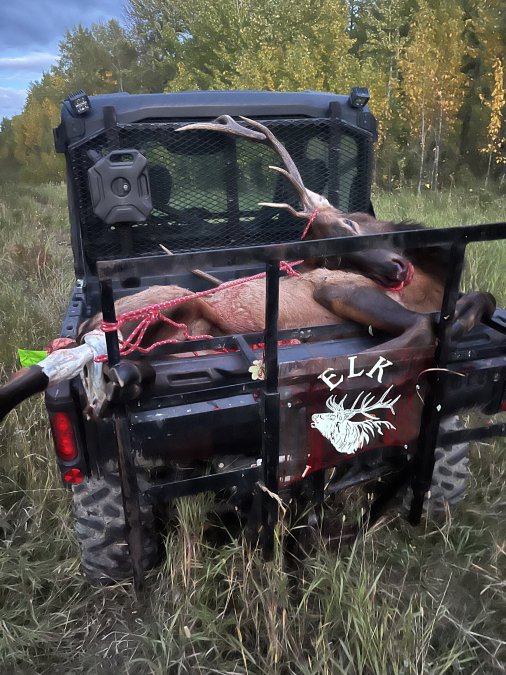
This is exactly the problem we built the Elk Hauler to solve.
The capacity matters for elk and moose: it handles a maximum load of 700+ lb, or your UTV's rated capacity, whichever is lower.
Here's how the main hauling approaches compare:
Method |
Best For |
Physical Load on Hunter |
Solo-Friendly |
|---|---|---|---|
Manual backpacking |
Short distances, small game |
High |
No |
Drag sled or tarp |
Flat, snowy ground |
Moderate |
Somewhat |
Game cart |
Established trails |
Moderate |
Somewhat |
UTV hitch attachment |
Rough terrain, large game |
Low |
Yes |
The trade-off is access: if your animal drops where a machine can't reach, you still have to move it first.
Footwear, Cutting Tools, and Field Dressing Gear
Boots and knives are the two pieces of gear where cheaping out costs you most. Both need to work with cold, tired hands and a body that's already been walking for hours. For senior hunters, ankle support and easy entry matter more than weight savings, and grip strength matters more than blade length.
Boot Selection for Aging Feet and Ankles
Footwear is where the ergonomics gap shows up fastest. Older feet lose fat padding on the sole, ankles stiffen, and balance reactions slow. That changes what to look for:
- Ankle support with a stiff shank. A nylon or composite shank protects against rocks and roots and reduces muscular work over uneven ground. A taller cuff (approximately 15-20 cm) gives more lateral support than a low-cut hiker.
- A waterproof membrane. Choose a breathable waterproof liner rather than a fully rubberized shell, which traps sweat. Wet feet turn into cold feet within an hour.
- Grip suited to your terrain. Softer rubber grips rock and wet logs better; harder compound lasts longer on scree and gravel. Match tread to where you actually hunt, not a generic "all-terrain" claim.
A common pattern is buying boots with rested, cool feet, then finding on the first cold hunt that the fit is too tight. Try boots on late in the day, with the socks you actually hunt in.
Knives and Cutting Tools for Reduced Grip Strength
Field dressing is a grip-strength task disguised as a cutting task. A dull blade forces you to push, and pushing is how you slip. For hunters with arthritis or reduced hand strength, the handle matters more than the blade:
- A handle that fills your palm with a slight palm swell or finger groove. A too-thin handle requires a tighter grip, which fatigues faster.
- A fixed-blade knife is easier to control than a folding model in the cold, with no hinge to work and no lock to release.
- A gut hook saves blind cuts when opening the abdominal cavity, where most accidental nicks happen.
- A replaceable-blade or easily sharpened system. Some hunters over 50 prefer replaceable blades so they never sharpen in the field with cold hands.
For field dressing technique, work at a height that doesn't require deep bending. Rolling the animal onto its back and propping it with a pack or log raises the working surface. Some hunters carry a short strap or cord to tie a leg out of the way, reducing how often they reposition.
Common Gear Mistakes Senior Hunters Make
The most common mistake is buying gear for the hunter you were ten years ago. Lightweight, adjustable, and easy to operate beats heavy-duty once joints start talking back.
Watch for these:
- Ignoring ergonomics until something hurts. Adjust your pack, sling, and boots before the season, not during it.
- Carrying too much "just in case" gear. Every extra kilogram is a tax you pay on every step.
- Skipping the pack-out plan. Most hunters plan the hunt and improvise the recovery. Reverse that.
- Buying boots a half size too small. Feet swell on long hikes, and tight boots cause blisters and cold toes.
A common mistake is spending the whole budget on optics and rifles, then dragging an elk out on your back at 58 because you never thought about recovery gear. The rifle doesn't hurt you.
Conclusion: Gear Built for the Long Haul
Hunting after 50 isn't about slowing down. It's about choosing gear that lets you keep going, season after season, without paying in recovery time.
If the pack-out is what's holding you back, we built the Elk Hauler for exactly that. It's a UTV receiver-hitch attachment that handles 700+ lb, mounts to most utility UTVs, and lets one person recover an elk or moose without dragging it.
Get started with Elk Hauler and take the strain out of your next pack-out.
Frequently Asked Questions
What gear helps senior hunters reduce physical strain?
The biggest wins come from reducing weight and removing manual lifting. Look for lightweight, articulated clothing that moves with you, boots with ankle support and a stiff shank, and a UTV-mounted hauling attachment so you are not dragging or lifting a quarter by hand. A receiver-hitch system like the Elk Hauler handles 700+ lb or your UTV's rated capacity, whichever is lower, and lets one person recover game without the back strain of a manual pack-out.
How can I make long hikes easier while hunting?
Start with a stretching routine before you leave the truck. Five targeted stretches for hips, hamstrings, calves, and shoulders loosen the muscles that carry weight and steady your aim. Pair that with moisture-wicking base layers, a pack that sits close to your spine, and trekking poles on steep ground. If you are hauling game out, use a UTV attachment instead of carrying it, which removes the heaviest part of the day.
Are there specific UTV attachments for hauling game to save my back?
Yes. A receiver-hitch attachment designed for large game lets you winch or load a quarter onto the carrier and drive it out. The Elk Hauler is purpose-built for elk, moose, and deer, mounts to most utility UTVs with a receiver hitch, and is operated by one person. It carries up to 700+ lb or your UTV's rated capacity, whichever is lower, so check your machine's rating before you order.
How do I choose comfortable hunting boots for senior foot health?
Prioritize ankle support, a stiff shank for rocky ground, and a waterproof membrane that still breathes. Look for a wider toe box to reduce pressure on bunions and a lacing system you can adjust with cold or stiff hands. Break boots in on short walks before the season, and replace the insoles with a cushioned pair if you stand for long periods. Silent movement matters too, so pick a sole that grips without squeaking on wet rock.