

Bow Uploader vs Great Day: UTV Game Hauler Comparison
Table of Contents
- Bow Uploader vs Great Day: What Actually Separates These Game Haulers
- Head-to-Head Performance: Load Capacity, Stability, and Field Results
- Long-Term Wear and Tear: Which System Holds Up Over Seasons
- How to Haul Elk with a UTV: Matching Your Hauler to Real Terrain
- UTV Game Recovery Systems: Mounting, Compatibility, and Solo Operation
- Best UTV Tires for Hauling Heavy Game: What Your Hauler Demands from Your Rig
- Which Game Hauler Fits Your Hunt: A Decision Framework
- Frequently Asked Questions
Last Updated: October 7, 2026
Bow Uploader vs Great Day: What Actually Separates These Game Haulers
The gap between a game hauler that works and one that fights you comes down to how it moves weight, not how it looks on a spec sheet. This comparison from Elk Hauler breaks down what separates the Bow Uploader and Great Day approaches to UTV game recovery, and where a purpose-built attachment fits into the picture. If you've ever wrestled a quarter onto a rack by hand at dusk, you already know why the mounting system matters more than the brand name.
Game hauler is a broad term. It covers everything from a simple cargo rack to a powered lift attachment that raises and lowers large game onto your UTV without manual lifting. The two names most hunters search for sit at opposite ends of that spectrum, and understanding the difference is the whole game.
Head-to-Head Performance: Load Capacity, Stability, and Field Results
Most comparisons stop at the spec sheet. This one doesn't. The two designs diverge in how they move weight, and that difference shows up the moment you're alone on a sidehill with a quarter that weighs more than you want to deadlift.
Here's the side-by-side breakdown on the factors that actually decide whether a solo hunt ends cleanly:
| Factor | Rack-Based (Bow Uploader-style) | Lift-Assisted (Great Day-style) |
|---|---|---|
| Loading method | Manual pivot-and-pull onto frame | Winch or crane arm raises load |
| Mechanical advantage | Leverage only | Winch ratio (commonly 2:1 to 4:1) |
| Solo operation | Workable for deer, hard for elk | Designed for one person |
| Stability on sidehills | Depends entirely on tie-downs | Anchored by mounting plate and frame |
| Moving parts | Few (pivot, bushings) | Many (cable, winch, pulleys, arm) |
| Setup time | Minutes | One-time install, longer |
| Failure mode | You strain, load slips | Cable or winch fails under load |
| Best for | Smaller game, moderate terrain | Elk, moose, steep or brushy ground |
Where the Bow Uploader approach wins: fewer moving parts means fewer failure points. A frame that helps you pivot weight upward reduces strain compared to a straight deadlift, and there's nothing to service beyond bushings and finish.
Where the Great Day approach wins: mechanical advantage. A winch-driven arm lets one person raise a full elk quarter without a second set of hands, which is the deciding factor when you're alone at last light on a cutblock.
The metric that matters most: how much weight one person can load without assistance. A rack-based system caps out around what you can physically pivot and hold; a lift-assisted system caps out around what the winch is rated for.
Long-Term Wear and Tear: Which System Holds Up Over Seasons
Durability isn't a spec, it's a pattern that shows up over seasons. Judging a hauler by its first fall tells you almost nothing. The real test is year three, after freeze-thaw cycles, mud, grit, and a few hundred kilometres of rough trail have done their work.
Here's how the two designs typically wear, component by component:
Rack-based (Bow Uploader-style):
- Pivot points and bushings are the first to go. They move under load every trip, so grease them or replace them before they seize.
- Frame finish, powder coat over steel resists rust better than bare metal, which matters in wet coastal and mountain conditions.
- Tie-down points stretch and fatigue. Inspect straps and anchor welds each season.
- Failure pattern: gradual. You'll feel a stiff pivot or a loose weld before anything lets go.
Lift-assisted (Great Day-style):
- Winch cable or strap is the critical wear item. Fraying, kinks, and rust shorten its life and it's the part most likely to fail under load.
- Pulleys and sheaves wear grooves that chew cable faster once they're out of round.
- Winch mechanism needs periodic service; a sticky brake or worn pawl is a safety issue, not just an inconvenience.
- Failure pattern: sudden. A cable that snaps under load drops the quarter and can send you back to square one.
The counterintuitive finding: a simpler system often outlasts a complex one, not because it's better built, but because there's less to fail. If you want minimal maintenance, fewer moving parts wins. If you want less physical strain, accept that you'll be servicing a mechanism every season.
A practical inspection routine that works for either design:
- Before every trip: check cable or strap for fraying, check tie-downs and quick-release hardware for looseness from vibration.
- Each season: grease pivot points, inspect welds, check frame drainage so water doesn't trap against the metal and rust it from the inside out.
- Every few years: replace bushings and cables on schedule, not after they fail.
How to Haul Elk with a UTV: Matching Your Hauler to Real Terrain
Matching a game hauler to terrain is the step most hunters skip. The right system for a flat alfalfa field is the wrong one for a steep, brush-choked drainage. Get this wrong and you'll fight the equipment every trip.
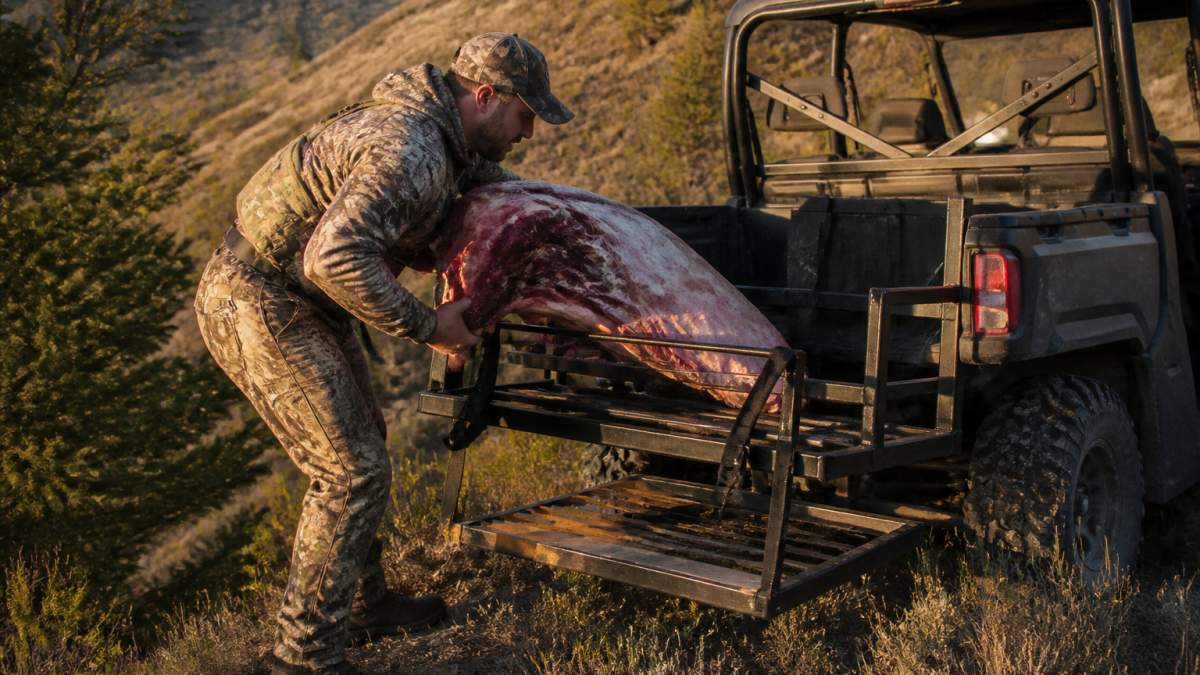
Start by mapping the ground you actually hunt. Elevation gain, trail width, and how far you park from the kill all shape what works.
- Steep slopes: you need a system that holds its position and doesn't tip when loaded off-centre.
- Heavy bush: a low-profile design clears branches and won't snag on the way in.
- Long pack-outs: mechanical assistance pays off when distance and weight stack up.
- Off-road access: ground clearance and mounting height matter as much as the hauler itself.
For a full walkthrough of the process, the Alberta Hunter Education Instructor Association offers guidance on responsible field practices. The core principle is simple: the less you lift by hand, the less likely you are to injure yourself far from help.
How do you load an elk onto a UTV alone?
You load an elk onto a UTV alone by using a system that raises the weight for you rather than asking you to lift it. A lift-assisted attachment or a winch-driven frame lets one person position and secure a quarter without a second set of hands. The key is anchoring the load before you move the machine.
UTV Game Recovery Systems: Mounting, Compatibility, and Solo Operation
Compatibility is the quiet dealbreaker. A system that doesn't fit your machine, or that fights your existing accessories, is useless no matter how well it performs on paper. Before you buy, confirm the mounting pattern matches your UTV's bed or frame.
Elk Hauler builds its attachment specifically for utility UTVs, engineered in Alberta and covered by U.S. Patent No. 12,419,301. It's designed so a single hunter can manage heavy game across rough ground, which is the whole point for anyone hunting solo.
- Mounting system: check that the attachment uses your UTV's existing anchor points.
- Quick-release design: lets you remove the hauler when you need the bed for other work.
- Weight distribution: keeps the load centred so the machine stays stable on sidehills.
- Solo operation: the deciding feature if you hunt alone most of the time.
If you're coming from a basic cargo rack, expect the install to take longer than bolting on a basket. The payoff is a system that does the heavy lifting so your back doesn't have to.
Best UTV Tires for Hauling Heavy Game: What Your Hauler Demands from Your Rig
Your tires carry the load your hauler lifts, so the two have to work together. A game hauler that raises a moose quarter onto a machine with worn or undersized tires just moves the problem to your traction.
For hauling heavy game, look for tires with a strong load rating, aggressive tread for off-road grip, and sidewalls that resist punctures from stumps and rock. Weight distribution shifts rearward when you load game, so rear traction and sidewall strength matter most.
- Load-bearing capacity: match the tire rating to the combined weight of game, hauler, and gear.
- Tread pattern: deeper lugs bite on mud, loose gravel, and wet grass.
- Sidewall toughness: reinforced sidewalls survive the bush better than thin ones.
- Pressure management: lower pressure improves grip but increases the risk of pinch flats under load.
The Canadian Centre for Occupational Health and Safety reminds operators that off-road vehicle stability changes with load, which is worth remembering when you're hauling a few hundred pounds of meat down a slope.
Which Game Hauler Fits Your Hunt: A Decision Framework
Choosing the right system comes down to your terrain, your game, and whether you hunt alone. Run your situation through this framework before you spend anything.
- Do you hunt alone most of the time? If yes, prioritize solo-operation design.
- Is your terrain steep or brushy? If yes, weight mechanical assistance higher.
- How heavy is your typical game? Elk and moose demand more than deer.
- How far do you pack out? Long distances reward mechanical help.
- How much maintenance will you actually do? Fewer moving parts, less upkeep.
- Does it fit your UTV's mounting points? Confirm before buying.
For hunters who want the lifting done for them, a purpose-built attachment like Elk Hauler's is the answer. It's engineered for elk, moose, and large game, built to handle heavy loads on real terrain, and designed so one person can operate it. That's the difference between a rack that holds weight and a system that moves it.
The Government of Canada's hunting regulations overview is worth a read before any season, since rules on transport and recovery vary by province.
Frequently Asked Questions
What is the primary difference between a Bow Uploader and a Great Day game hauler?
The two systems take different approaches to lifting game onto a UTV. One prioritizes a compact, bow-specific mounting design, while the other offers a more adjustable platform built around broader load versatility. The practical difference shows up in how each handles weight distribution during a lift, how much deck space it occupies, and whether a single hunter can operate it without a second person stabilizing the load. Match the design to your most common retrieval scenario rather than the spec sheet.
Can a single hunter operate these game hauling attachments effectively?
It depends on the lifting mechanism and how the load is anchored during the raise. Systems that use a winch or pivot arm let one person manage a heavy quarter without holding tension manually. Systems that require you to lift and guide simultaneously are harder to run solo, especially on sloped ground where footing is already compromised. If you hunt alone most of the season, test the operating sequence before you commit.
Are these UTV game recovery systems compatible with all UTV models?
No. Mounting systems vary by receiver size, bed configuration, and whether your machine has a factory or aftermarket rack. Older UTVs that have been modified with custom beds or welded racks often need adapter plates. Before buying, confirm the mounting footprint matches your machine and check whether the system accounts for weight distribution once a full quarter is loaded. A hauler that fits but overloads your rear suspension is not a fit.
How do these systems handle heavy game like moose or elk?
Elk quarters typically run 60 to 90 pounds each, and moose quarters can exceed that. What matters is not just rated capacity but how the hauler manages leverage during the lift and whether the load stays stable once raised. Look for systems with a locking position or tensioned anchor point so the load does not shift while you are driving. On rough ground, a hauler that lets the load swing will wear out both the attachment and your patience.
Hauling heavy game out of rough country is the part of the hunt that ends seasons early and wrecks backs. Elk Hauler solves it with a UTV attachment engineered specifically for elk, moose, and other large game, built in Alberta and backed by a U.S. patent and a 1-year warranty. It's made for one-person operation across any terrain, so you can focus on the hunt instead of the pack-out. Get started with Elk Hauler and simplify your next recovery.