

Is a UTV Game Hoist Worth It? An Honest 2026 Breakdown
Table of Contents
- The Real Cost of Manual Game Recovery
- UTV Game Hoist Weight Capacity: What You Actually Need
- Hitch-Mounted vs. UTV-Mounted Systems
- Is a UTV Game Hoist Worth It for Solo Hunters?
- How to Load a Moose Into a UTV
- The Best UTV Game Loader for Elk: What to Look For
- DIY Winch Hacks vs. a Purpose-Built Hoist
- Maintenance, Wear, and What Breaks First
- Frequently Asked Questions
Last Updated: September 25, 2026
The Real Cost of Manual Game Recovery
A UTV game hoist is a hitch- or bed-mounted lifting system that raises big game onto a utility vehicle using a winch, cable, and pivoting arm. The question of whether a UTV game hoist is worth it comes down to one number: what a blown back costs you versus what the attachment costs you.

That's the real cost. Not the hoist. The recovery.
UTV Game Hoist Weight Capacity: What You Actually Need
Weight capacity is the first spec that separates a useful hoist from a decorative one. Look for a load rating that clears your heaviest realistic lift with margin, not your average one.
Matching Lift Limits to Elk and Moose Quarters
Match capacity to the animal, not the brochure. A bull elk hind quarter can run well over 100 lbs, and a moose quarter is heavier again. Add the weight of the gambrel and cable, and your working load climbs fast.
Why Swivel Arms and Wired Remotes Matter
A swivel arm lets you swing the load over the UTV bed instead of dragging it sideways across the tailgate. That single pivot point is the difference between a controlled lift and a wrestling match.
Hitch-Mounted vs. UTV-Mounted Systems
Hitch-mounted systems win for most hunters because they use the receiver you already have. No drilling, no permanent modification, and you can move the unit between machines.
| Feature | Hitch-Mounted | UTV-Mounted |
|---|---|---|
| Installation | Receiver hitch, hitch pin, wiring | Drilling or frame brackets |
| Portability | Moves between machines | Fixed to one machine |
| Bed space used | None | Some bed space |
| Best for | Hunters running utility UTVs | Dedicated hunting rigs |
Is a UTV Game Hoist Worth It for Solo Hunters?
Yes, for solo hunters it usually is, because the alternative is doing alone what is genuinely a two-person job. A UTV game hoist is worth it when you hunt alone, hunt big game, and hunt terrain you can't drive right up to.
Back Strain Prevention and Aging Hunters
This is the part most reviews skip. Hunters over 50 aren't buying a hoist for speed. They're buying it to keep hunting at all.
How to Load a Moose Into a UTV
Loading a moose solo starts with positioning: get the UTV as close and as level as the terrain allows, then lift in quarters rather than whole. Work methodically and let the hoist do the pulling.
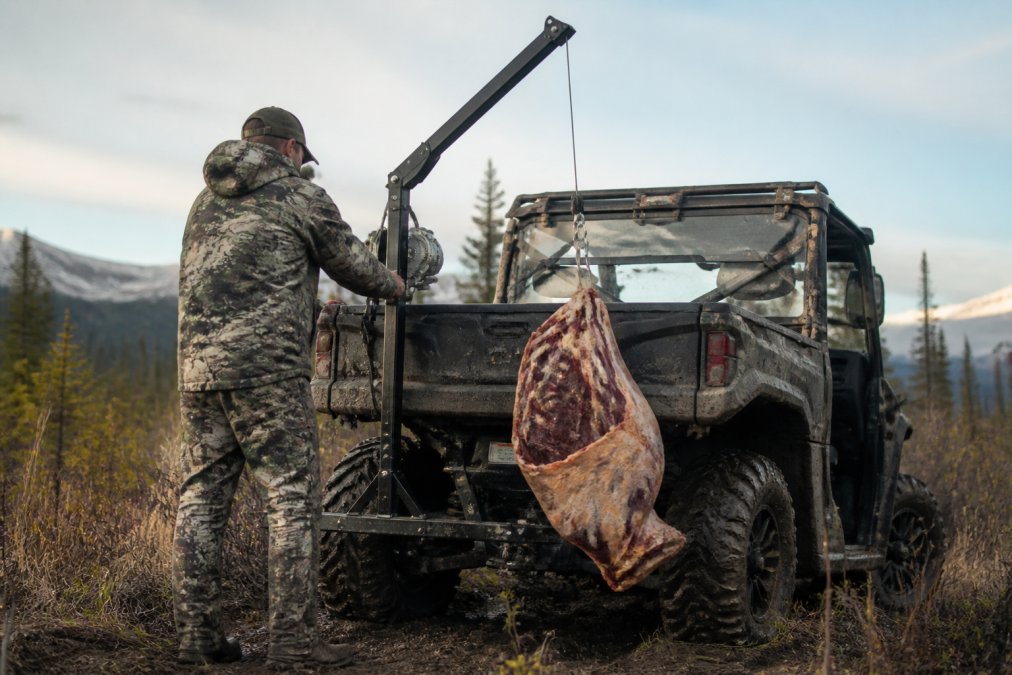
Here's the sequence that works in practice:
- Field dress and quarter the moose, leaving hide on if you're moving fast.
- Back the UTV to the closest stable, level ground you can reach.
- Attach the gambrel to the quarter and hook the cable.
- Stand clear and lift with the remote, guiding the swivel arm over the bed.
- Lower, release, and repeat for each quarter.
The Best UTV Game Loader for Elk: What to Look For
The best UTV game loader for elk balances capacity, mounting simplicity, and one-person operation. Elk country is steep and brushy, so portability and a reliable lift matter more than extra features.
Check these before you buy:
- Load rating that clears a heavy elk quarter with margin
- Mounting that uses your existing receiver hitch
- Swivel arm for controlled placement over the bed
- Wired remote so you stay clear of the load
- Build quality in the cable, pulley, and mounting bracket
DIY Winch Hacks vs. a Purpose-Built Hoist
Most top-ranking articles tell you to buy a hoist. Almost none break down what the DIY route actually costs you in parts, time, and risk. That gap matters, because the honest answer to "is a UTV game hoist worth it" depends on whether you're comparing it to a $1,500 product or to a Saturday in the garage with a receiver winch you already own.
What the DIY Winch Hack Actually Requires
A workable DIY setup usually needs all of the following:
- A receiver-mounted winch (many hunters already own one for recovery work)
- A snatch block to redirect the line and double the pulling force
- A gambrel or spreader bar rated for the load
- A length of rated cable or strap, plus shackles
- A pivoting arm or boom you fabricate or bolt on, so the load clears the tailgate
- A way to anchor the boom so it doesn't fold under load
Where DIY Setups Fail
A winch pulls in a straight line. A game hoist has to pull up and then swing sideways over the bed. Those are different jobs, and a winch bolted to a receiver doesn't naturally do the second one.
Common failure points practitioners report:
- Boom flex. A fabricated arm that isn't triangulated bends under a heavy quarter, and once it bends it never lifts straight again.
- Anchor failure. The receiver hitch is designed for towing loads along the frame, not for a vertical moment arm hanging off the back. A long boom multiplies the force on the hitch pin and bracket.
- Cable angle. Without a proper pulley arrangement, the cable rubs the boom or the tailgate, fraying fast and cutting capacity.
- No controlled swing. You end up dragging the load across the tailgate instead of pivoting it, which is the exact problem a swivel arm solves.
The Real Cost Comparison
| Approach | Upfront Cost | Time to Build | Reliability |
|---|---|---|---|
| DIY winch and pulley hack | Lower parts cost, but you likely already own the winch | Several weekends of fabrication and testing | Varies; depends entirely on your build and welding |
| Purpose-built hoist | $1,500 (Elk Hauler) | Minutes to install | Tested, warrantied |
The dollar figure on the DIY side looks smaller until you count the winch you're repurposing, the steel, the welding, and the weekends. If your time is worth anything and you hunt far from home, the gap narrows fast.
When DIY Makes Sense
DIY is the right call if you enjoy fabrication, hunt close to home where a failure is an inconvenience rather than a crisis, and already own a suitable winch. It's also a reasonable path if you only lift deer-sized loads and never plan to touch a moose quarter.
When a Purpose-Built Hoist Wins
A purpose-built hoist wins when you need it to work the first time, in the dark, on a slope, with a heavy load and no help. That's the scenario the query is really about. Elk Hauler mounts to your receiver hitch, lifts 700+ lbs, and is designed for one-person operation.
Maintenance, Wear, and What Breaks First
No top-ranking article covers what a game hoist costs you after the purchase. That's the missing half of the "is it worth it" question. A hoist that needs a new cable every season is a different value proposition than one that runs five years on the original.
The Wear Order
Parts fail in a predictable sequence. Knowing the order tells you what to inspect first and what to keep as a spare.
- Cable or strap. First to go. Steel cable frays where it bends over the pulley and where it contacts the boom. A strap wears at the stitch line and the anchor point.
- Pulley and sheave. Second. A worn sheave groove lets the cable ride on the flange instead of the bottom, which accelerates cable wear and can pinch the line.
- Remote wiring and connections. Third. Vibration and weather work on the plug and the switch long before the motor gives trouble.
- Mounting bracket and hitch pin. Fourth, but the most serious when it happens. Cracks start at weld toes and bolt holes.
- Winch motor and gearbox. Usually last, and usually only if water got in.
Inspection Intervals That Actually Work
- Before every season: full cable inspection along its whole length, pulley spin test, bracket and weld inspection, remote function test.
- After every heavy lift: quick visual on the cable at the pulley and the boom anchor.
- Mid-season if you hunt hard: re-grease the pulley and check the hitch pin for elongation.
A cable that's kinked, flattened, or showing more than a few broken strands is done (CCOHS: Materials Handling). Replace it before the next hunt, not after.
Rust and Storage
Steel cable and bare brackets rust. The fix is boring but effective: dry the unit after wet hunts, keep it out of the weather between trips, and touch up any chipped coating on the bracket before rust gets under it. A light oil on the cable slows corrosion without attracting grit the way grease does.
What This Means for the Worth-It Math
One more factor most buyers ignore: weight distribution. Load the heaviest quarters over the axle or toward the front of the bed, not hanging off the tailgate. A hoist makes the lift easy, but where you place the load still decides how your machine handles on the drive out.
Frequently Asked Questions
Can a single hunter load a moose or elk into a UTV alone?
Yes, with the right equipment. A hitch-mounted UTV game hoist with a wired remote lets one person lift and swing 700+ lbs of game into the bed without a second set of hands. The mechanical advantage does the lifting while you steer the load. Without a hoist, most solo hunters quarter the animal and make multiple trips, which takes longer and risks spoiling meat in warm weather.
How much weight can a standard UTV game hoist handle?
UTV game hoist weight capacity varies by model, but purpose-built units typically handle 700+ lbs. That covers a full elk quarter or a deboned moose. Check your UTV's receiver hitch rating too, since the hoist's load transfers through the hitch. A hoist rated for 700 lbs on a hitch rated for 500 lbs means the hitch is your limiting factor, not the hoist.
Are UTV game hoists compatible with all cargo beds?
Most hitch-mounted hoists work with any utility UTV that has a standard receiver hitch, so cargo bed dimensions matter less than hitch compatibility. The Elk Hauler mounts directly to your receiver with a hitch pin and wiring connection. If your UTV has been modified, check that the receiver is intact and rated for the load before buying any hoist.
Is a winch-based game hoist better than a manual ramp?
It depends on your terrain and whether you hunt solo. A manual ramp works on flat ground with two people, but it's awkward on slopes and useless when you're alone. A winch-based hoist with a wired remote lets you load from the driver's side while the cable does the pulling. For steep or bush-heavy terrain, the winch system wins on safety and speed.
How much does a UTV game hoist cost compared to a DIY setup?
The Elk Hauler UTV attachment costs $1,500.00 and ships across Canada and the United States with a 1-year limited warranty. A DIY winch-and-pulley setup might run a few hundred dollars in parts, but you're building mounting brackets, wiring, and a lifting arm yourself, with no warranty and no guarantee it handles 700+ lbs safely. Factor in your time and the risk of a field failure.
Manual recovery is the part of the hunt that ends seasons early, and it's the part a hoist is built to remove. If you hunt big game solo, in steep or brushy country, and you're tired of gambling your back on every pack-out, Elk Hauler is the tool made for that exact job. It mounts to your receiver hitch, lifts 700+ lbs, and lets one person recover an elk or moose without dragging or waiting for help. Get started with Elk Hauler and take the strain out of the pack-out.