

Preventing Back Injury During Elk Hunting: 2026 Guide
Table of Contents
- Why Elk Hunting Breaks Down Your Back
- Best Stretches for Hunters Before Long Hikes
- Hunting Pack Weight Distribution Tips
- Core Stability Training for Pre-Season Conditioning
- Using UTV Attachments for Game Recovery
- Safe Dragging and Post-Injury Field Management
- Conclusion
- Frequently Asked Questions
Last Updated: September 28, 2026
Why Elk Hunting Breaks Down Your Back
Elk hunting is one of the few pursuits where the hardest work starts after the animal is down. A mature bull can dress out well past 300 kilograms, and every kilogram has to travel from where it fell to your vehicle across kilometres of blown-down timber, sidehill, and creek bottom.
The Biomechanics of a Heavy Pack-Out
Load distribution is the single biggest factor in whether a heavy pack leaves you sore or injured. When weight sits high and close to your spine, your lumbar spine stays neutral and your posterior chain does the work. When weight pulls backward and down, your spine arches and the muscles along your vertebrae take load they were never meant to hold.
Best Stretches for Hunters Before Long Hikes
A proper stretching routine before a long hike raises blood flow to cold tissue and rehearses the range of motion you are about to demand. Skip it and you start with tight hips and a stiff lumbar spine, the exact setup for a strain on the first steep pitch.
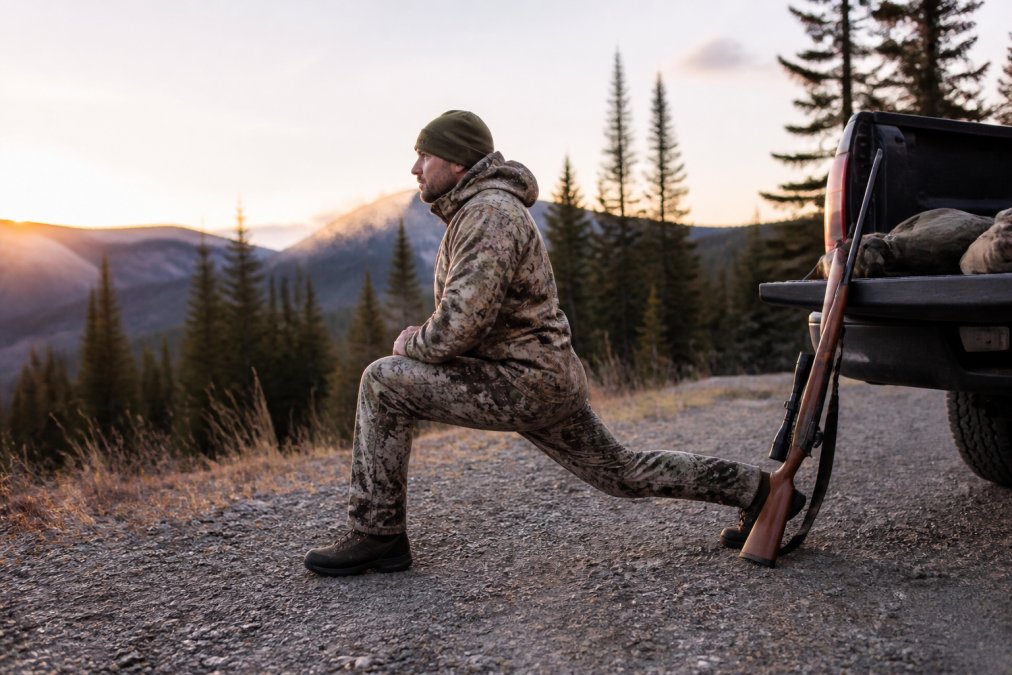
A 10-Minute Pre-Hunt Stretching Routine
Run this sequence before you leave the truck. It takes ten minutes and needs no equipment.
- Leg swings (front-to-back and side-to-side) - 10 reps per leg to open the hips
- Walking lunges - 10 per leg to wake up the glutes and quads
- Cat-cow spinal rolls - 10 slow reps to mobilise the vertebrae
- World's greatest stretch - 5 per side for hip and thoracic mobility
- Bodyweight squats - 15 reps to prime the legs for heavy lifting
- Arm circles and shoulder rolls - 30 seconds each direction for pack straps
- Standing torso twists - 10 per side for spinal alignment
Hunting Pack Weight Distribution Tips
Pack weight placement decides how far you can carry a load before your form breaks. The rules are simple, but most hunters ignore them when tired, and almost no guide covers the elk-specific problem: getting a 45 to 70 kilogram quarter onto your back without wrecking your spine.
The Quartering and Loading Sequence
The lift is the dangerous part, not the carry. A quartered hindquarter weighs 45 to 70 kilograms and is awkward, bloody, and slippery, loading it wrong is how you herniate a disc five kilometres from the trailhead.
- Quarter on the ground, not on your back. Break the animal down completely before you put anything on. Never try to lift a whole hindquarter from a standing position.
- Position the pack downhill of the meat. If the quarter is on a slope, kneel below it so you are lifting toward your centre of mass, not away from it.
- Roll, don't lift. Get the quarter onto your knee, then onto the pack bag while the pack is still on the ground. Use your legs to stand, not your back.
- Stand with the pack on the ground first, then shoulder it. Put the pack on like a backpack while it sits at knee height, tighten the hip belt, then stand. This is the single most important habit in this section.
- Re-tighten everything once standing. Hip belt first, then load lifters, then shoulder straps, then sternum strap. In that order.
Fitting Your Hip Belt and Load Lifters
Your hip belt should carry 70 to 80 percent of the load, not your shoulders. A correctly fitted belt sits on the iliac crest and transfers weight through your hips rather than your lumbar spine. If your shoulders take the weight, your belt is too loose or sitting too high.
| Pack Component | Job | Adjustment Cue |
|---|---|---|
| Hip belt | Carries 70-80% of the load | Sits on the iliac crest, snug not tight |
| Load lifters | Pulls load toward your spine | 45-degree angle to the shoulder strap |
| Shoulder straps | Stabilises, not supports | Light pressure, no numbness |
| Sternum strap | Keeps straps from spreading | Level with your armpits |
Frame Pack Selection for Heavy Loads
Core Stability Training for Pre-Season Conditioning
Core stability is what lets your lumbar spine hold a neutral position under load for hours. It is not about a six-pack, it is the deep muscles that brace your spine when a 45-kilogram quarter shifts on a sidehill. Most articles say 'strengthen your core' and stop; that is useless without a timeline, load target, and progression.
What You Are Actually Training For
A mature bull quartered out yields four loads in the 45 to 70 kilogram range, plus a head and cape. On a typical mountain pack-out you carry that 3 to 8 kilometres per trip, over 300 to 600 metres of elevation gain, on rarely flat ground. Your posterior chain and deep core must hold a neutral spine for 60 to 120 minutes per carry while your legs climb.
An 8-Week Pre-Season Block
This is a structured periodised plan, not a random workout list. Run it in the eight weeks before your season opens; with more time, repeat the base phase.
Weeks 1-3: Base strength. Three sessions per week. Focus on movement quality under moderate load.
- Goblet squats, 3 sets of 8
- Romanian deadlifts, 3 sets of 8
- Front planks, 3 sets of 30 seconds
- Bird dogs, 3 sets of 10 per side
- Farmer's carries, 3 sets of 40 metres at 20 kg per hand
Weeks 4-6: Build phase. Add load and duration. This is where the pack-out-specific work starts.
- Back squats or trap-bar deadlifts, 4 sets of 6
- Weighted step-ups onto a 40 cm box, 3 sets of 10 per leg
- Suitcase carries, 3 sets of 40 metres at 25 kg, one side only, to train anti-lateral flexion
- Weighted planks, 3 sets of 45 seconds with a 10 kg plate
- Loaded pack carries, 3 sets of 400 metres at 25 kg, building to 35 kg by week 6
The Loaded Carry Is the Whole Point
If you only do one thing from this plan, do loaded carries. A heavy pack carry mimics a pack-out better than any gym exercise: it loads your spine vertically, challenges your grip, and forces your core to brace against a shifting load. Start at 20 kg and add 2 to 3 kg per week; by the end of the build phase you should carry 35 kg for 400 metres on uneven ground, roughly half a quartered elk, and the best predictor of finishing a pack-out without a strain.
Posture Correction Belongs in the Plan
Canadian Centre for Occupational Health and Safety manual materials handling guidance
Using UTV Attachments for Game Recovery
The most reliable way to prevent back injury during elk hunting is to remove the heaviest manual work from the equation entirely. A UTV attachment for game recovery lets you winch and carry an animal out without ever lifting a quarter onto your shoulders.
Safe Dragging and Post-Injury Field Management
Dragging a whole elk is the fastest route to a soft tissue injury you will feel for months. If you must drag, use a harness or drag line attached at your hips, keep your spine neutral, and pull with your legs. Never bend at the waist and haul with your arms.
Conclusion
The gap between a successful hunt and a season-ending injury usually comes down to planning, not luck. Conditioning, load management, and the right equipment all reduce the strain your spine absorbs on the worst day of the season.
Frequently Asked Questions
What is the most effective way to prevent back injuries during elk hunting?
The most effective approach combines three things: pre-season core stability training, a properly fitted pack with a load-distributing hip belt, and mechanical assistance for the heaviest loads. Your lumbar spine handles compression poorly under 70-plus pound loads on uneven ground. Training your posterior chain and hip belt technique reduces the strain, while a UTV attachment eliminates the most dangerous phase entirely, the initial lift and drag of a whole elk or moose.
What are the best exercises to prepare for elk hunting season?
Build your pre-season training around posterior chain strength and core stability. Deadlifts, weighted step-ups, farmer carries, and bird-dog variations all translate directly to carrying heavy loads on mountain terrain. Add single-leg work for balance on scree and deadfall. Start 12 to 16 weeks before opening day and periodize: build strength first, then shift to loaded carries and hiking with weight. This conditioning protects your vertebrae when you're packing out quarters at dusk.
How should you properly lift heavy game to avoid back strain?
Never bend at the waist to lift a quarter or a whole carcass. Get close to the load, hinge at the hips with a neutral spine, and drive up with your legs. Keep the load tight to your chest. If the animal is too heavy to lift safely, quarter it in place rather than dragging it whole. Dragging a 600-pound elk across uneven ground is one of the most common causes of soft tissue injury and disc problems in hunters.
How does mechanical assistance change the physical demands of a pack-out?
A UTV attachment like the Elk Hauler, which mounts to your receiver hitch and handles 700-plus pounds, removes the repeated heavy lifting and dragging that damages the lumbar spine. Instead of dead-lifting quarters onto your shoulders, you winch or roll the load onto the attachment. One person can complete the recovery without waiting for help, which matters when you're hunting solo and meat quality depends on speed.