

UTV Game Loader for Steep Slopes: Safe Setup Guide
Table of Contents
- What You'll Need Before You Load on a Slope
- Step 1: Measure the Slope Angle and Know Your UTV's Limits
- Step 2: Position the UTV and Set Up Your Game Loader
- Step 3: Match Your UTV Winch Capacity for Game Loading
- Step 4: Control the Descent with Engine Braking and Traction
- Is a UTV Game Hoist Worth It for Steep Terrain?
- Safe Game Retrieval Techniques for Solo Hunters on Slopes
- Common Mistakes to Avoid on Steep Slopes
- Frequently Asked Questions
Last Updated: October 2, 2026
What You'll Need Before You Load on a Slope
Loading a bull elk on a 25-degree hillside is a different job than loading one on flat ground. Before you touch a UTV game loader for steep slopes, sort five things: a winch rated above your load, a slope-measuring method, chocks or a trusted parking brake, a safety tether, and a spot to stand where a rolling quarter can't take you out.
- Winch with a rating above your heaviest expected load
- Inclinometer app, angle finder, or a level and ruler
- Chocks, wheel blocks, or a rated parking brake
- Safety tether or strap for the load
- Gloves, and a clear escape path downhill
Step 1: Measure the Slope Angle and Know Your UTV's Limits
You cannot manage a slope you haven't measured. Most hunters guess "about 20 degrees" and are off by ten, the difference between a controlled lift and a tip-over.
How to Measure Slope Angle Without Fancy Tools
A smartphone inclinometer app gets you close enough for planning: lay the phone flat on the slope surface. For a no-tech method, place a level on a board, raise one end until level, and measure rise over run. A 30 cm rise over 100 cm of run is roughly 17 degrees.
What Slope Angle Is Too Steep for a UTV?
No single number applies to every machine. Manufacturers publish gradeability and tip-over figures in the owner's manual, but those assume a stock machine on dry ground with no load. Add a 300 kg elk carcass high on the rack and the real limit drops fast.
Step 2: Position the UTV and Set Up Your Game Loader
Positioning is where steep-slope loading is won or lost. Park across the slope, not facing up or down it, so chassis stability works with gravity instead of against it.
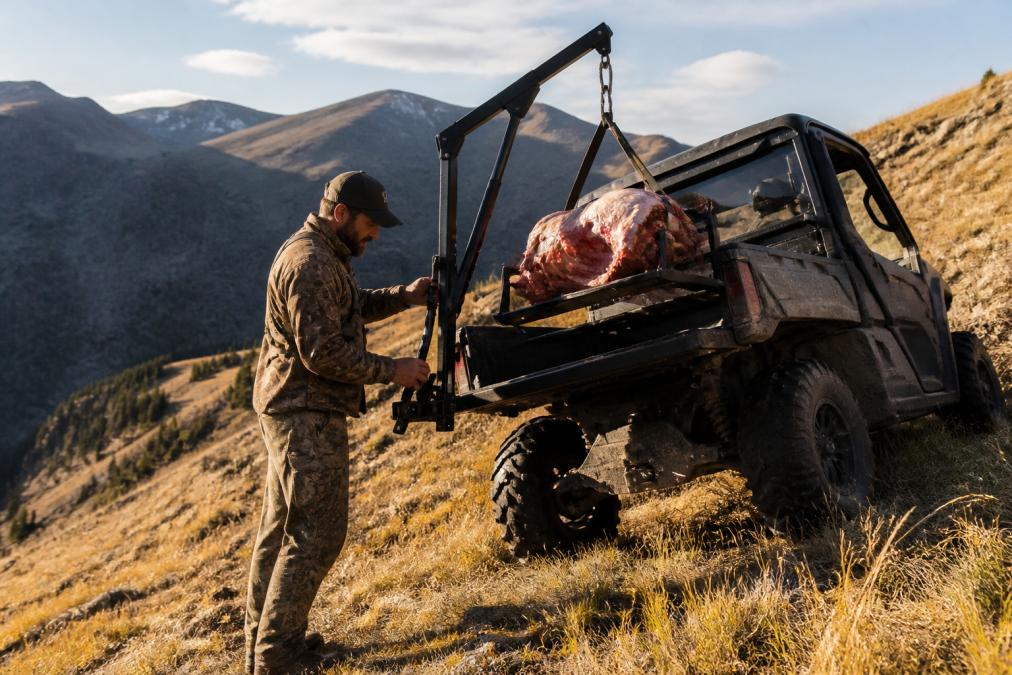
Why Center of Gravity Decides Everything on a Slope
Every load raises the combined center of gravity of the UTV and its cargo. On flat ground a high load is annoying; on a slope it flips you. Keep the heaviest part of the load low and near the machine's centerline, and never let a quarter hang off one side.
Step-by-Step Loading Procedure on an Incline
- Chock the downhill wheels and set the parking brake.
- Anchor the winch line or hoist to the load from uphill if possible.
- Lift slowly, keeping the load centered over the rack.
- Tether the load before you release tension on the winch.
- Re-check the machine's stance before you move.
Step 3: Match Your UTV Winch Capacity for Game Loading
Winch sizing for steep-slope game loading differs from flat-ground recovery. Gravity adds a slope component, and the drum's rated line pull drops as rope spools out. Most hunters size to load weight and stop there, which is why winches stall mid-lift on a 25-degree hillside.
The Slope Component You Have to Add
On flat ground, pulling a 300 kg load takes roughly 300 kg of force plus friction. On an incline, required force climbs with the sine of the slope angle. A useful rule of thumb:
- 10 degrees: add roughly 17% to the load weight
- 20 degrees: add roughly 34%
- 30 degrees: add roughly 50%
Line Pull Drops as the Drum Fills
A winch's rated capacity is measured on the first wrap of rope on the drum. By the third or fourth wrap, line pull can fall 25% to 40% depending on drum diameter and rope type, so on a short pull with a full drum, you may have well under the number printed on the box.
Mechanical Advantage with a Snatch Block
A single snatch block rigged as a simple pulley roughly doubles pulling power while halving line speed (Tech Tip Tuesday: Double-line = Double Power). On steep ground where control matters more than speed, that trade is almost always worth it. Two cautions:
- Rig the block to a rated anchor point, not to the loader arm unless the manufacturer rates it for that load.
- Doubling the pull also doubles the load on the anchor and the line, so inspect both before every lift.
Matching Winch Class to UTV Class
A common pattern among hunters working steep ground:
UTV class |
Typical winch class |
Notes |
|---|---|---|
Mid-size utility (approx. 500-700 cc) |
3,500-4,500 lb |
Adequate for deer and antelope quarters on moderate slopes |
Full-size utility (approx. 700-1000 cc) |
4,500-6,000 lb |
Handles elk and moose quarters with a snatch block on steep ground |
Heavy-duty / crew |
6,000 lb and up |
Reserve capacity for snow, mud, and multi-quarter loads |
These are starting points, not guarantees. The right number is the one that clears your slope-adjusted load with margin left over.
Synthetic Rope vs. Steel Cable on Slopes
Synthetic rope is lighter, safer if it snaps, and easier to handle with gloves on a cold hillside. Steel cable resists abrasion better against rock edges. Either can work on steep, rocky ground, but inspect for fraying or glazing after every steep-slope lift. A shock-loaded line gets replaced, not re-spooled.
The Two Jobs Your Winch Does on a Loader
On a UTV game loader for steep slopes, the winch is not just lifting, it also holds the load while you tether it. That means holding a static load on an incline, not just moving it. A winch with a brake rated for the slope-adjusted load is the difference between a controlled lift and a runaway quarter.
Step 4: Control the Descent with Engine Braking and Traction
Descent is where loaded UTVs get away from their operators. Going up, gravity fights you and you feel it. Going down, gravity helps you, and it's easy to underestimate how fast a loaded machine builds speed on a loose grade. Most steep-slope accidents happen on the way down.
Slope Angle Limits by UTV Class (Loaded)
No manufacturer publishes a loaded-slope rating, because the safe angle depends on load weight, load height, tire condition, and ground surface. What follows is a planning guide from common patterns among hunters and off-road operators, not a manufacturer spec. Verify against your own owner's manual.
UTV class |
Unloaded gradeability (typical manual figure) |
Practical loaded limit on dry, firm ground |
Practical loaded limit on loose or wet ground |
|---|---|---|---|
Mid-size utility |
15-20 degrees |
10-12 degrees |
8 degrees or less |
Full-size utility |
20-25 degrees |
12-15 degrees |
10 degrees or less |
Crew / long-wheelbase |
20-25 degrees |
12-15 degrees |
10 degrees or less |
Two rules override the chart:
- If the load sits high on the rack, subtract several degrees from the practical limit. A tall load raises the combined center of gravity and shortens the tipping moment.
- If you are unsure whether the slope is within limits, it is not. Walk the load down or find another line.
Engine Braking in Low Range
Low range is not just for climbing. It multiplies engine braking on descent, the most effective way to hold a loaded UTV back on a grade without cooking the brakes. On a long descent:
- Select low range before you start down, not partway.
- Stay off the brakes except for short corrections.
- If you feel the machine accelerating despite engine braking, you are on too steep a grade for the load. Stop, reassess, and consider walking the load down.
Traction, Tires, and Airing Down
Traction on descent comes from contact patch and tread, not horsepower. Practical adjustments:
- Air down slightly to widen the contact patch on rough or loose ground. Check your tire's sidewall for the minimum safe pressure and do not go below it.
- A 4x4 utility vehicle in low range gives descent control a two-wheel-drive machine cannot match. If you only have 2WD, treat every steep descent as a higher-risk operation.
- Aggressive tread helps in mud and snow but can dig in on loose gravel and reduce control. Match the tire to the ground you actually ride.
- Inspect tires for sidewall damage before a loaded descent. A tire that fails under load on a slope is a recovery problem, not a repair problem.
Descent Procedure for a Loaded Machine
- Confirm the load is tethered and centered before you move.
- Select low range and 4x4 before the grade begins.
- Pick your line from the top, not partway down.
- Keep the machine straight; turning on a loaded descent is where rollovers happen.
- Maintain a slow, steady speed. If speed builds, stop and reassess rather than braking harder.
- Keep an escape route in mind at every point on the grade.
When to Walk the Load Down Instead
If the slope exceeds your loaded limit, the ground is loose or wet, or the load sits high and off-center, break the load into smaller carries or use a rope and pulley from a stable anchor. A slow walk-down beats a fast rollover, no pack-out is worth a machine on top of you.
Is a UTV Game Hoist Worth It for Steep Terrain?
For most solo hunters working steep ground, yes. The question isn't whether a hoist helps, it's whether you can safely lift a heavy quarter onto a rack by hand on an incline. Most hunters over 50 can't, and shouldn't try.
Safe Game Retrieval Techniques for Solo Hunters on Slopes
Solo retrieval on steep ground follows one rule above all: never put your body between the load and the downhill. Work from the uphill side, keep your feet planted, and use the machine's mechanical advantage, not your own muscle.
- Lift with the winch, not your back
- Keep an escape route downhill clear at all times
- Tether the load before releasing winch tension
- Take your time; a slow pack-out beats a fast injury
Common Mistakes to Avoid on Steep Slopes
The mistakes that hurt people are predictable: loading with the machine facing up or down the slope instead of across it, trusting a winch rated at load weight with no margin, skipping the tether, standing downhill of a load that can roll. Each is easy to fix and hard to recover from.
Mistake |
Fix |
Why It Matters |
|---|---|---|
Parking up/down the slope |
Park across the slope |
Improves chassis stability |
Winch rated at load weight |
Add headroom or a snatch block |
Slope adds resistance |
Skipping the tether |
Tether before releasing tension |
Prevents load roll |
Standing downhill |
Work from uphill side |
Keeps you clear of the load |
Frequently Asked Questions
How do you safely load a moose or elk onto a UTV on an incline?
Park the UTV across the slope, not facing up or down, so the load stays level. Set the parking brake, chock the wheels, and attach a safety tether to the animal before lifting. Use a game loader with a winch or manual crank to raise the animal in stages. Keep the load close to the ground until the UTV is stable, then secure it with straps. Never stand downhill of the load, and keep hands clear of cables and moving parts.
Are UTV game hoists stable enough for steep mountain terrain?
Stability depends on how you mount and operate the hoist. A hoist fixed to a 2-inch receiver hitch or steel rack mounting plate distributes weight better than a clamp-on unit. On steep terrain, always park across the slope and use a safety tether. A hoist with a wide base and articulating suspension helps keep the load centered. Check your UTV's load capacity and never exceed it, even if the hoist itself can lift more.
What safety precautions should be taken when operating a UTV on steep slopes?
Measure the slope angle first; many UTVs lose stability beyond 15 to 20 degrees, and some models have lower limits. Engage 4x4 and low range, keep your foot off the brake on descents to let engine braking work, and avoid sudden turns. Use a safety tether on any load, wear a helmet, and tell someone your route. If the slope feels too steep to walk up comfortably, it is too steep to drive across with a heavy load.
Can a single hunter manage a large game retrieval using a UTV attachment?
Yes, with the right attachment and technique. A purpose-built loader lets you winch or crank the animal onto the rack without lifting. Position the UTV so the loader arm reaches the animal, secure it with a tether, then raise it in stages. Keep the UTV parked and braked during the lift. Practice on flat ground first to learn the controls, and always have a plan for what happens if the load shifts.
Steep-slope retrieval punishes guesswork. Elk Hauler builds a UTV attachment specifically for hauling elk and moose on real terrain, with one-person operation, U.S. Patent No. 12,419,301, and a 1-year warranty behind it. Get started with Elk Hauler and take the strain out of your next pack-out.