

UTV Game Lift vs Manual Pack Out: Which Wins?
Table of Contents
- UTV Game Lift vs Manual Pack Out: The Real Comparison
- Total Effort Across the Full Recovery Route
- How to Load an Elk Into a UTV
- Choosing a UTV Game Loader: What Actually Matters
- Electric vs. Manual Game Hoist: Which Fits Your Hunt?
- Safety and Injury Risks Beyond Back Strain
- Time, Cost, and Setup: A Real-World Breakdown
- Frequently Asked Questions
Last Updated: October 16, 2026
UTV Game Lift vs Manual Pack Out: The Real Comparison
A mature bull elk can dress out past 600 pounds, and every pound has to travel from where it fell to your truck. That is why the utv game lift vs manual pack out question matters: one method moves the animal with mechanical assistance, the other on your legs, one trip at a time.

At Elk Hauler, we build equipment for exactly this problem, so we have a clear bias. But both methods have a place, and the deciding factors are animal size, terrain, distance, and who is with you. Below, we break down what each approach demands, where each wins, and how to choose.
What Each Method Actually Involves
Manual pack out means quartering, bagging, loading a frame pack, and walking. A bull elk typically means four to six trips, each covering the same ground twice over deadfall, scree, or swamp.
A UTV game lift changes the math. You still field dress and quarter, but the UTV does the carrying. With a receiver-mounted attachment, one person can load and move the animal without lifting it by hand.
Quick Comparison Table
| Factor | UTV Game Lift | Manual Pack Out |
|---|---|---|
| Trips required | One, if terrain allows | Four to six |
| Physical strain | Low, mechanical assist | High, repeated loads |
| Terrain limits | Needs UTV-accessible ground | Works almost anywhere |
| Solo friendly | Yes | Difficult with large game |
| Setup time | Minutes to install | None, but hours of walking |
| Best for | Elk, moose, short distances to a road | Deep backcountry, no vehicle access |
Total Effort Across the Full Recovery Route
Most comparisons stop at the moment of lifting, but the real cost is the whole route from kill site to tailgate, and the two methods distribute it very differently.
Manual pack out front-loads the effort into your body.
A UTV game lift front-loads the effort into access. If you can get the machine within a few hundred yards of the animal, the recovery collapses into a single run: quarter, load, drive out.
The catch is that "close" is doing a lot of work in that sentence. Before you plan a route, check the vehicle-access rules for your zone and season, provincial hunting regulations and access rules and the relevant land-manager maps are the starting point, since motorized access is restricted in many wildlife management units, on some Crown leases, and inside provincial parks and protected areas.
A Decision Framework by Animal Size, Terrain, and Distance
Use this matrix to pick a method before the season, not at the kill site:
| Animal (dressed weight) | Distance to vehicle | Terrain | Recommended method |
|---|---|---|---|
| Deer / antelope (80-150 lb) | Under 1 mile | Any | Manual pack out, one or two trips |
| Deer / antelope | Over 1 mile | Any | Manual pack out or cart; lift only if UTV access exists |
| Elk (200-250 lb boned) | Under 1 mile | UTV-accessible | UTV game lift, single run |
| Elk | Under 1 mile | Steep, blowdown, no trail | Manual pack out, four to six trips |
| Elk | Over 1 mile | UTV-accessible to within 500 yd | UTV game lift plus a short pack to the machine |
| Moose (400-600 lb boned) | Any | UTV-accessible | UTV game lift; manual pack out is a multi-day effort |
| Moose | Any | No vehicle access | Manual pack out with a partner, or hire a packer with horses |
The pattern is simple: a game lift wins on effort whenever the terrain and the rules let you use it. Manual pack out wins whenever they do not, or when the animal is small enough that the machine is not worth the setup.
Low-Impact and Legal Considerations
A UTV is not always the right answer even when it is the fast one. Motorized recovery can compact soil, rut wet ground, and damage sensitive habitat, and many jurisdictions restrict it for that reason. In a roadless area, walk-in-only zone, or park, manual pack out is the only legal option. Plan the method around the rules, not the other way around.
How to Load an Elk Into a UTV
Loading an elk into a UTV comes down to four steps: position the machine, secure the attachment, raise the load, and confirm it is stable before you move.
Here is the sequence we recommend for a receiver-mount setup:
- Park the UTV on the flattest, most stable ground you can find, ideally facing downhill from the animal.
- Insert the attachment into the receiver hitch and secure it with the hitch pin.
- Connect the wiring if your unit uses powered operation.
- Quarter the animal and move each quarter to the machine, keeping the load as close to the UTV as possible.
- Raise the load with the mechanical assist rather than lifting it by hand.
- Verify the load is centered and secured before you drive.
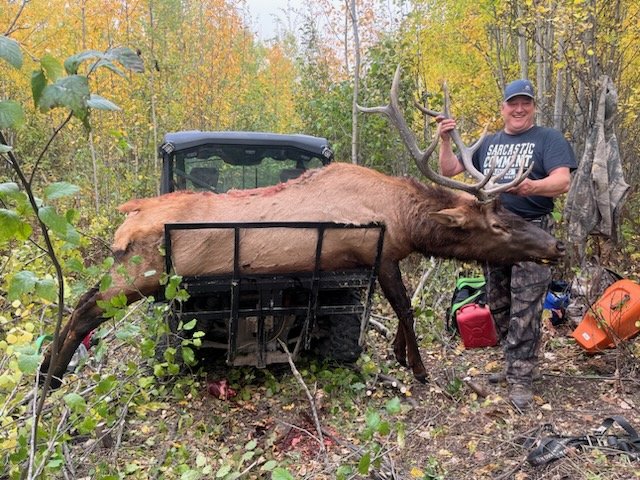
The biggest mistake is loading on a sidehill. A UTV carrying several hundred pounds on a slope is unstable, and the load shifts as you raise it.
Never exceed your UTV's rated capacity. A lift rated for 700+ lb still cannot make a machine carry more than its manufacturer allows, and an overloaded side-by-side on uneven ground is a rollover waiting to happen.
Choosing a UTV Game Loader: What Actually Matters
A UTV game loader is only as good as its fit with your machine and terrain. Three things decide whether it works: mounting configuration, load capacity, and how much work it removes from your body.
Capacity is the first filter. Elk and moose are heavy, and a loader that struggles with a mature bull is not much use.
Fit is the second filter. A modified older UTV can still work, but confirm receiver compatibility before you buy. If unsure, ask the manufacturer directly rather than guessing.
Rack and Receiver-Mount Configurations
Rack-mounted systems sit on the cargo bed and rely on the machine's existing structure. Receiver-mount systems slide into the hitch and use the frame for support. Receiver mounts are easier to remove and swap between machines; rack systems distribute weight differently but are harder to install and remove.
For a solo hunter, receiver-mount is usually the simpler choice. It installs in minutes, comes off when you do not need it, and keeps the bed free for gear on the drive in.
Electric vs. Manual Game Hoist: Which Fits Your Hunt?
An electric game hoist uses a powered winch to raise the load.
Electric wins on effort: if your back is the reason you are shopping, powered operation removes almost all the lifting.
Manual wins on simplicity. A hand crank or pulley has nothing to drain, wire, or short out in wet conditions.
For most solo hunters the question is simple: do you supply the force, or the machine? If your body is the limiting factor, go powered.
Safety and Injury Risks Beyond Back Strain
Back strain gets the attention, but the bigger dangers in a pack out are falls, rollovers, and getting caught under a shifting load.
Manual pack out exposes you to fall risk on every trip; add darkness, steep ground, and fatigue, and the odds stack up. A UTV game lift removes most of the walking but adds its own hazards: an off-camber machine with a heavy load high on the frame is unstable, and an unsecured load can shift on a bump.
The practical rules are the same either way:
- Keep the load as low and centered as your setup allows.
- Never travel with an unsecured load.
- Take the flatter route, even if it is longer.
- Stop when you are tired. Fatigue causes more field accidents than inexperience.
Time, Cost, and Setup: A Real-World Breakdown
Cost is where the two methods look furthest apart and where the comparison misleads most. Manual pack out costs nothing up front; a UTV game lift costs money. But the up-front price is not the whole number.
Setup and Recovery Time
Manual pack out has no setup time and a long recovery time. A typical elk pack out runs four to six hours for a fit solo hunter on moderate ground, and eight to twelve hours or more in steep, brushy, or wet terrain, plus a second trip the next day for a moose or in warm weather.
A receiver-mount UTV game lift installs in minutes, insert, pin, wire if powered, and go. Recovery drops to roughly one to two hours from kill to tailgate when the machine can reach the animal, most of it quartering and loading rather than walking.
Cost Comparison
| Cost category | Manual pack out | UTV game lift |
|---|---|---|
| Equipment purchase | $150-$500 (frame pack, game bags, knives) | $1,000-$2,500 for a receiver-mount attachment |
| Fuel / transport | $0 extra | Fuel to run the UTV, plus trailer or truck bed space |
| Time per elk recovery | 4-12 hours | 1-2 hours when access allows |
| Meat loss risk | Higher in warm weather; multi-trip delays cooling | Lower; single run shortens kill-to-cooler window |
| Body cost | Cumulative wear on back, knees, shoulders | Minimal lifting; risk shifts to machine stability |
A receiver-mount attachment like the Elk Hauler runs $1,500.00, ships across Canada and the United States, and is backed by a 1-year limited warranty against manufacturing defects. It is protected under U.S. Patent No. 12,419,301 and engineered in Alberta for the kind of terrain that makes pack outs miserable.
The Number That Actually Matters
Divide the purchase price by the seasons you expect to use it. A $1,500.00 lift used on three elk over five seasons works out to $100.00 per animal, less than the fuel and ice you burn saving meat from a slow pack out.
Setup is minutes. Compare that to the hours of walking a manual pack out demands, and the trade-off is not really about money.
The right question is not which method is cheaper. It is how many seasons of heavy pack outs your back has left, and whether the terrain you hunt lets a machine do the work instead.
Frequently Asked Questions
Is a UTV game lift worth it compared with a manual pack-out?
It depends on how far you hunt from the truck and how heavy your game is. A UTV game lift removes the repeated bending, lifting, and carrying that a manual pack-out demands, and it lets one person handle an elk or moose without a partner. If you hunt solo, are over 50, or routinely take large game in steep terrain, the time and strain savings usually justify the cost. For short, flat retrievals of smaller deer, a manual pack-out may be enough.
Can one person load big game onto a UTV with a game lift?
Yes. A receiver-hitch attachment like the Elk Hauler is built for one-person operation. You insert it into the receiver, secure it with the hitch pin, connect the wiring, and use the mechanical advantage to lift the load onto the rack. The 700+ lb maximum load (or your UTV's rated capacity, whichever is lower) covers elk and moose quarters. Always check your UTV's rating and receiver compatibility before ordering.
Does a UTV game lift work on uneven or rough terrain?
It works on any terrain your UTV can safely handle. The lift mounts to the receiver hitch, so once the UTV is parked on stable ground, the attachment does the lifting regardless of slope. The key is positioning the UTV safely before you start. Avoid parking on loose sidehills or near drop-offs, and chock the wheels if you're on an incline. If you're unsure whether your setup suits your terrain, contact the manufacturer before buying.
What are the advantages of a manual lift over an electric game hoist?
A manual crank or pulley setup has no battery drain, no wiring, and fewer parts to fail in cold weather. That reliability matters when you're miles from the trailhead in late-season conditions. Electric hoists reduce your physical effort further but depend on a power source and add weight. For hunters who want simplicity and don't mind the extra cranking, a manual lift is often the more dependable choice.