

Best Game Recovery Tools for Seniors: 2026 Guide
Table of Contents
- Why Game Recovery Gets Harder After 50 (and What Actually Helps)
- Large Game Recovery Equipment: What to Look For
- UTV Game Hauler Attachments: How They Compare
- Safe Game Hauling Techniques for Rough Terrain
- Solo Elk Recovery: Planning and Gear for One Person
- Common Mistakes That Lead to Injury (and How to Avoid Them)
- Conclusion: Choosing the Right Game Recovery Tools for Your Needs
- Frequently Asked Questions
Last Updated: October 12, 2026
Why Game Recovery Gets Harder After 50 (and What Actually Helps)
Game recovery is the process of getting a harvested animal from where it fell to your vehicle or home, and it gets harder after 50 because the body loses muscle mass, grip strength, and joint resilience with age.
Aging is not the only factor. Rough ground, long distances, and heavy quarters all stack up. Canadian Centre for Occupational Health and Safety guidance on manual materials handling explains that the risk of back injury rises sharply when a load is lifted away from the body and twisted, which is exactly what happens when you try to drag an elk quarter over uneven ground.
The good news: recovery tools for seniors do not need to be complicated. A few well-chosen pieces of equipment, plus smarter technique, remove most of the strain.
Large Game Recovery Equipment: What to Look For
Large game recovery equipment for seniors should prioritize stability, low effort, and simple operation over raw speed. The best setup runs alone, in the dark, without bending, kneeling, or gripping hard.
Look for three things: a wide, stable base so nothing tips on uneven ground; a mechanical advantage, such as a winch or pulley, that does the pulling for you; and controls you can reach without kneeling. WorkSafeBC guidance on preventing musculoskeletal injuries notes that reducing the force a worker must apply is one of the most effective ways to cut injury risk, and the same principle applies to hauling game.
Age-Specific Selection Criteria
Most recovery-tool guides are written for athletes in their twenties and thirties. The criteria change past 50, and again if you manage a common health condition. Use these filters before you buy:
- Grip diameter and texture. Thin handles force a tight pinch grip, the first thing to go with age. Look for handles at least 3 cm thick with a rubberized or foam sleeve, and avoid bare metal in cold weather.
- Trigger and control effort. Powered winches with a remote or dash-mounted switch beat hand cranks for anyone with arthritis in the hands or wrists. If you must crank, a two-speed crank with a long handle reduces force per turn.
- Balance and center of gravity. Leaning over a UTV bed loads the lower back. Favor designs where the load travels toward you at waist height, not over your head or below your knees.
Low-Cost and Low-Effort Options
Not every hunter needs a powered system. A tiered approach lets you match spend to effort:
| Tier | Example Tools | Setup Effort | Best For |
|---|---|---|---|
| No-cost | Rope and pulley you already own, tarp drag, downhill gravity pull | Low | Flat ground, short distances, backup |
| Low-cost | Hand winch, game cart with large wheels, drag harness | Moderate | Moderate terrain, hunters who can still pull |
| Mid-range | Manual crank boom mounted to UTV bed | Moderate | Solo hunters who want to avoid lifting |
| Higher-cost | Powered winch boom, UTV-mounted hauler | Low | Rough terrain, solo hunters, heavy game |
The no-cost and low-cost tiers are underrated. A simple 2:1 pulley system using rope you already own can cut the force needed to move a quarter roughly in half, often enough to make a short drag manageable. A game cart with large, wide wheels rolls over rough ground far better than a sled and keeps the load off your back entirely.
Weight Ratings and Terrain Capability
Weight ratings matter more than marketing claims. Check the stated capacity and stay well under it, a rating is a ceiling, not a target. A system rated for a full elk will handle a moose quarter with room to spare.
Terrain capability comes down to traction and clearance. A UTV game hauler attachment keeps the load off your body entirely, which is why it suits older hunters better than dragging.
Setup, Takedown, and Storage
If a tool takes twenty minutes to set up, you will stop using it. Favor attachments that mount to a standard UTV bed with minimal tools and fold or detach for storage.
| Equipment Type | Effort to Operate | Best For | Storage Needs |
|---|---|---|---|
| UTV-mounted hauler | Low | Solo hunters, rough ground | Moderate, stays on machine |
| Hand winch and pulley | Medium | Short drags, backup | Small |
| Drag sled or tarp | Medium-high | Flat, short distances | Small |
| Manual carry | High | Very short distances only | None |
UTV Game Hauler Attachments: How They Compare
A UTV game hauler attachment mounts to your side-by-side and lifts or pulls large game into the bed, replacing manual lifting. For most hunters over 50, it is the single biggest upgrade available.
Here is how the main categories stack up.
| Attachment Style | Operation | Terrain Fit | Solo Use |
|---|---|---|---|
| Powered winch boom | One person, from the seat | Steep, brushy | Yes |
| Manual crank boom | One person, more effort | Moderate | Yes |
| Rear rack and ramp | Two people preferred | Flat to moderate | Limited |
| Bed-mounted crane | One person | Anywhere UTV can go | Yes |
The powered and manual boom styles win on solo use because you never lift the animal yourself.
Elk Hauler builds a UTV attachment designed specifically for this job.
Safe Game Hauling Techniques for Rough Terrain
Safe game hauling on rough terrain starts with positioning: park the UTV on the most level ground available, even if that means a longer pull, and always work from the uphill side so the load moves toward you.
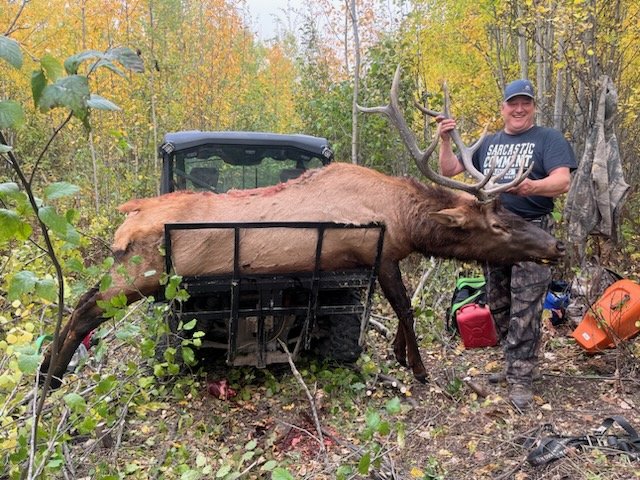
Keep these rules in mind:
- Set the parking brake and chock the wheels before you pull anything.
- Keep the pull line low and straight to avoid side-loading the machine.
- Never stand downhill of a load that could roll.
Solo Elk Recovery: Planning and Gear for One Person
Solo elk recovery works when you plan it before the shot, not after. Know where the animal is likely to fall and how you will get the UTV to it.
Gear that makes solo recovery realistic:
- A UTV-mounted hauler so you never lift a quarter by hand
- A good headlamp, since much of the work happens after dark
- Game bags and a tarp to keep meat clean and cool
- A satellite messenger for emergencies, because you are alone
The mental load matters too. A solo hunter who has rehearsed the steps moves calmly and avoids the rushed, twisting lifts that cause injury.
Common Mistakes That Lead to Injury (and How to Avoid Them)
The most common mistake older hunters make is treating recovery as a sprint. But the mistakes that actually send hunters over 50 to the clinic are more specific than "lift with your legs", they cluster around fatigue, cold, and the decision to keep going when you should stop.
| Mistake | Fix | Why It Matters |
|---|---|---|
| Lifting quarters by hand | Use a UTV attachment or pulley | Removes the strain entirely |
| Working downhill of the load | Always work uphill | Prevents being crushed |
| Skipping the parking brake | Set brake and chock wheels | Stops runaway machines |
| Rushing in the dark | Slow down, use good light | Fatigue causes errors |
| Pulling with cold, stiff muscles | Warm up and layer up | Cold tissue tears more easily |
| Ignoring numbness or tingling | Stop and reassess | Can signal nerve or circulation trouble |
| Skipping food and water | Eat and drink on a schedule | Dehydration worsens fatigue and balance |
| Going alone without a check-in plan | Use a satellite messenger | No one knows where you are |
The Fatigue Cascade
A common pattern in late-season recoveries is what practitioners call a fatigue cascade: the first hour goes fine, the second brings sloppy footwork, and by the third the hunter is making decisions they would never make fresh.
Cold amplifies this. Cold muscles are less elastic and more prone to strain, and cold hands lose grip strength quickly. Keep a warm layer in the UTV, wear gloves that let you work a winch control, and warm up before the first pull rather than treating it as the warm-up.
When to Stop and Call for Help
Some signals mean stop, not push through:
- Chest pain, shortness of breath, or dizziness
- Sudden weakness or numbness on one side of the body
- A pop or sharp pain in the back, knee, or shoulder
- Numbness or tingling in the hands or feet that does not go away when you change position
If any of these happen, stop the recovery. The meat can wait. Use your satellite messenger or phone to call for help, and do not try to drive yourself out if you are dizzy or in severe pain.
Cognitive Fatigue and Game Recovery
There is a second meaning to "game recovery" that most guides ignore: recovering mentally from long, focused gaming sessions. If you or the person you are buying for spends hours at a screen, the tools are different. Breaks every 30 to 60 minutes, good lighting to reduce eye strain, a chair with proper back support, and hydration do more for next-day comfort than any gadget.
Conclusion: Choosing the Right Game Recovery Tools for Your Needs
Choosing the best game recovery tools for seniors comes down to one question: can you run it alone, without lifting, on the ground you actually hunt? If yes, you have the right setup.
At Elk Hauler, we built our UTV attachment around that exact problem. It is purpose-built for elk and moose, U.S. patented, and engineered in Alberta to let a single hunter manage heavy game across rough terrain, eliminating back strain and simplifying the pack-out so you can focus on the hunt.
Get started with Elk Hauler and take the strain out of your next recovery.
Frequently Asked Questions
How can older hunters reduce strain when hauling game?
Older hunters can reduce strain by using mechanical aids like UTV game haulers, winches, and game carts instead of dragging or carrying quarters. Break the animal into smaller loads, use proper lifting form (bend knees, keep load close), and take frequent breaks. Planning the route and having a partner or communication device adds safety. Staying hydrated and fueling with protein and carbs also supports muscle recovery after the haul.
What should seniors consider when choosing game recovery gear?
Seniors should prioritize ease of use, weight limits, and stability. Look for UTV attachments that can be operated solo, have clear instructions, and fit your existing machine. Consider whether you need a winch, ramps, or a hoist. Check the physical demands: can you attach and detach it without strain? Also factor in storage space, warranty, and customer support. Test the gear on flat ground before heading to steep terrain.
Is a UTV attachment useful for recovering elk or moose?
Yes, a UTV attachment like a game hauler can be very useful for elk or moose recovery. It lets you lift and secure heavy quarters onto the UTV without manual lifting, reducing back strain. Look for attachments that are compatible with your UTV's hitch or bed, have a sufficient weight capacity, and can be operated by one person. Some models, such as the Elk Hauler, are designed specifically for large game and rough terrain.
What is the safest way to move game over rough terrain?
The safest way is to use a UTV or game cart with wide wheels, go slowly, and avoid steep side slopes. Secure the load with straps, keep the weight low and centered, and use a winch if you need to pull the animal up a slope. Never try to carry a heavy quarter alone; instead, quarter the animal and make multiple trips. Wear gloves and non-slip boots, and tell someone your plan before heading out.