

Game Loading System vs Manual: Which Wins in 2026?
Table of Contents
- Game Loading System vs Manual: The Real Trade-Off
- What Counts as a Game Loading System
- What Manual Loading Actually Involves
- Side-by-Side Comparison: Effort, Speed, and Safety
- Manual Elk Pack-Out: Where It Works and Where It Breaks Down
- What a UTV Game Hoist Changes About the Pack-Out
- Game Retrieval Equipment: What to Look For Before You Buy
- Choosing by Game Type, Terrain, and Player Preference
- Common Mistakes When Switching to a Loading System
- Frequently Asked Questions
Last Updated: October 9, 2026
Game Loading System vs Manual: The Real Trade-Off
A game loading system is a mechanical attachment that lifts and secures big game onto a vehicle; manual loading means lifting and dragging the animal by hand. The trade-off comes down to effort, speed, and safety.
Every hunter who has packed out an elk solo knows the moment: the animal is down, the light is fading, and the real work is just starting. Manual loading works fine on flat ground with a partner, but falls apart on a steep slope, in deep bush, or when you're alone.
What Counts as a Game Loading System
A game loading system is any powered or mechanical setup that lifts game onto a vehicle without you doing the heavy lifting. Common versions include UTV-mounted hoists, winch-and-pulley rigs, and loaders that pivot off a hitch or rack. The key difference is mechanical advantage: the system does the work while you guide the load.
Most systems share a few core parts:
- A mounting point on the UTV or trailer
- A boom, arm, or pivot
- A winch, crank, or ratchet
- A strap, cradle, or hook for the animal
Some systems handle a full animal. Others work best with quarters. Elk Hauler builds a UTV attachment designed for elk, moose, and other large game, with one-person operation in mind.
What Manual Loading Actually Involves
Manual loading means lifting, dragging, and wrestling game onto a vehicle with nothing but muscle and rope. The process: field dress and quarter the animal, drag each quarter to the vehicle, lift it to rack or bed height, and repeat. On flat ground with two people, this is manageable. Add a slope, mud, or deep brush and it gets brutal fast. Manual loading also slows you down, and every trip back costs time and energy that matter when you're trying to cool meat fast.
Side-by-Side Comparison: Effort, Speed, and Safety
Most comparisons of a game loading system versus manual loading stop at "one is easier, one is cheaper." A real comparison breaks the pack-out into five stages, approach, secure, lift, transport, and unload, and scores each method against them.
| Stage | Manual Loading | Loading System |
|---|---|---|
| Approach | Drag or carry each quarter to the vehicle | Same, but you can stage quarters closer to the rig |
| Secure | Rope, strap, or paracord around the quarter | Hook, cradle, or strap integrated with the lift arm |
| Lift | Full body lift to rack or bed height, often overhead | Mechanical lift; you guide, the system raises |
| Transport | Load shifts if strapping is rushed | Load sits in a fixed cradle or boom position |
| Unload | Reverse the lift, often with cold, tired muscles | Controlled lower, same as the lift |
The lift stage is where manual loading breaks down.
Effort. Manual loading is a full-body effort on every quarter; a system converts that into a guided lift, and the difference compounds across four quarters plus the head and cape.
Speed. Manual loading is slower because you rest between lifts; a system lets you keep moving, which matters on a warm day.
Safety. Manual loading concentrates risk in the lift. A loading system concentrates risk in setup and stability, which you can control before the hunt.
Setup and cost. Manual loading needs nothing but rope. A loading system needs a mount, a test fit, and practice.
Best for. Manual loading suits short, flat, partnered pack-outs. A loading system suits steep, remote, solo hunts and heavy game.
| Factor | Manual Loading | Loading System |
|---|---|---|
| Effort | High, all muscle | Low, mechanical lift |
| Speed | Slow, multiple trips | Faster, fewer trips |
| Safety | Higher injury risk | Lower strain on back |
| Setup | None needed | Mount and test first |
| Best for | Short, flat pack-outs | Steep, remote, solo hunts |
How to Load an Elk onto a UTV by Hand
Loading an elk onto a UTV by hand means quartering the animal, then lifting each piece to rack height one at a time. The process: quarter and bag the meat, drag each quarter to the UTV, lift it to the rack or bed, strap it down, and repeat. The hard part is the lift. A rear rack sits high, and on a slope you're also fighting gravity and footing. This is where most solo hunters run into trouble.
A common pattern is to underestimate the second and third quarters. The first lift feels manageable. By the third, your grip and lower back are fatigued, and that's when form breaks down and injuries happen. If you're loading by hand, plan your rests and keep the heaviest quarters for when you're freshest.
Manual Elk Pack-Out: Where It Works and Where It Breaks Down
Manual loading works best on short, flat pack-outs with help nearby. It breaks down on steep ground, in thick bush, and on solo hunts where there's no one to share the load. Picture a gentle walk out on a logging road with two hunters and a quarter each, manual loading handles that fine. Now picture a steep cutblock, 2 km from the road, and you're alone. Every trip back costs time, your back takes a beating, and meat cools slower. That's where manual loading stops being practical.
A common mistake is waiting until the animal is down to think about the pack-out. The method should be decided before the season, not at dusk on a hillside.
What a UTV Game Hoist Changes About the Pack-Out
A UTV game hoist turns the pack-out into a one-person job. The hoist lifts the load while you guide it, so your back never takes the full weight.
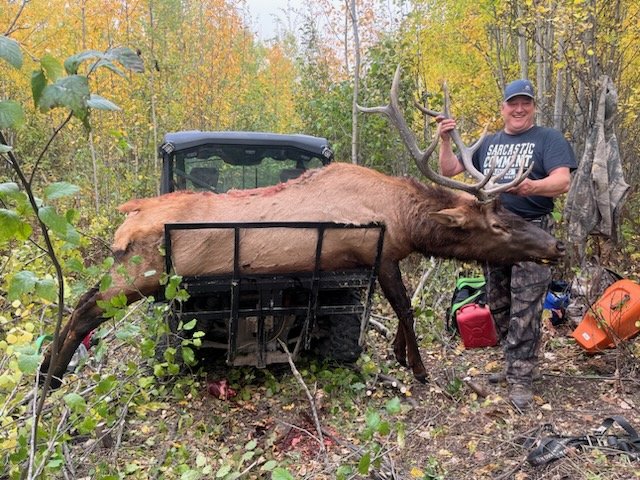
The biggest change is control: you position the UTV, hook the load, and lift, the mechanical arm does the lifting, not your back. That matters most when you're alone, since a hunter who can't lift a heavy quarter by hand can still run a hoist. Speed improves too, and fewer trips and less rest between lifts means the meat cools faster.
Game Retrieval Equipment: What to Look For Before You Buy
Game retrieval equipment should match your vehicle, your terrain, and how you hunt. The right setup lifts heavy game safely. The wrong one adds weight and gets in the way.
Check these before you buy:
- Mounting fit: Does it work with your UTV's rack, hitch, or bed?
- Lift capacity: Can it handle a full elk quarter or a whole moose?
- One-person operation: Can you run it solo, start to finish?
- Stability on slopes: Does it stay steady on uneven ground?
- Build quality: Will it hold up to brush, mud, and cold?
- Support and warranty: Is there real backup if something breaks?
Weight and storage matter too. A system that's hard to mount or stows poorly becomes a hassle you leave at home.
Elk Hauler's attachment is built for elk, moose, and other large game, is U.S. patented, and is engineered in Alberta for one-person use on real terrain. It's designed to fit utility UTVs and simplify the pack-out.
Choosing by Game Type, Terrain, and Player Preference
Most guides tell you to "match the method to the hunt" and leave it there. That's a slogan, not a decision.
Start with the game. Small game and deer rarely justify a mechanical system, since one person can lift a field-dressed deer to a tailgate or rack.
Then the terrain. Flat ground with vehicle access keeps manual loading viable. Steep cutblocks, deep bush, and long approaches push you toward a system because every extra trip costs time and energy.
Then the hunter, the variable most guides ignore. Age, back history, and whether you hunt solo often matter more than the game or terrain.
Here's a structured way to decide:
| Scenario | Recommended Method | Why |
|---|---|---|
| Deer, flat ground, short drag, two hunters | Manual | Weight and distance are manageable |
| Elk or moose, steep terrain, any hunter count | Loading system | Lift weight and slope risk dominate |
| Solo hunter, any large game | Loading system | No one to share the lift or spot the load |
| Two or more hunters, easy vehicle access | Manual can work | Shared effort offsets the lift |
| Aging hunters or past back issues | Loading system | Removes the highest-risk moment |
| Rural property, year-round hauling | Loading system | Adds value beyond hunting season |
Player preference splits into two camps. Some hunters value simplicity and don't want another piece of gear to mount, store, and maintain.
Accessibility is the angle most comparisons skip.
The honest answer: most hunters who pursue large game in steep or remote terrain, or who hunt alone, are better served by a loading system. Most who hunt small game or deer on accessible ground with help are fine with manual loading. Everything in between is a judgment call to make before the season.
Common Mistakes When Switching to a Loading System
The biggest mistake is buying before you measure. A system that doesn't fit your UTV or terrain wastes money and time.
Watch for these:
- Skipping the fit check: Measure your rack, hitch, and bed first
- Ignoring slope stability: Test on the ground you hunt, not the driveway
- Overloading the system: Stay within the rated capacity
- No solo practice: Run the full lift alone before opening day
- Poor strapping: A loose load shifts and can fall mid-lift
- No backup plan: Know what you'll do if the lift fails
Another common error is waiting until the animal is down to learn the system. Practice in the off-season with sandbags so you're fast and calm instead of fumbling in the dark.
The pack-out is the part of the hunt nobody talks about, and it's the part that breaks backs and wastes meat. Manual loading still works on easy ground with help. But when the terrain is steep, the game is heavy, and you're alone, a loading system changes everything.
Elk Hauler builds a UTV attachment made for exactly that moment. It's purpose-built for elk, moose, and large game, U.S. patented, engineered in Alberta, and designed for one-person operation on real terrain.
Get started with Elk Hauler and make your next pack-out a one-person job.
Frequently Asked Questions
What is a UTV game loading system?
A UTV game loading system is any attachment or setup that lifts and secures big game onto a side-by-side without you deadlifting the weight. That includes winch-driven hoists, pivoting loaders, and rack-mounted lift arms. The point is to move the load with mechanical advantage instead of your back, so a single hunter can manage an elk or moose quarter alone in the field.
Is a UTV game hoist worth it compared to a manual pack-out?
It depends on your terrain, your age, and how often you hunt solo. A manual elk pack-out means multiple trips and heavy lifting on uneven ground, which is where most back injuries happen. A hoist or loading system cuts the number of lifts and lets one person handle the load. If you hunt steep or bush-heavy ground regularly, the effort saved adds up fast.
Can one person load an elk onto a UTV?
Yes, with the right game retrieval equipment. A winch-driven hoist or pivoting loader lets you anchor the animal, lift it mechanically, and swing it onto the rack without lifting the full weight yourself. Doing it by hand usually means dragging, rolling, and a two-person lift, which is risky on slopes. A single hunter can manage it alone when the system does the lifting.
Is a game hoist safer than manual loading?
Mechanical lifting removes the repeated heavy pulls and awkward twists that cause most pack-out injuries. Manual loading forces you to lift dead weight from low, unstable positions, often on a slope. A hoist keeps the load controlled and lets you stay balanced. No system removes all risk, but the reduction in strain on your back and shoulders is the main reason hunters switch.